Showing posts with label Ifugao. Show all posts

Friday, November 21, 2008

A Return to the Native: Ifugao Chronicles 2

I FOUND MUCH OF MY early November days organizing thoughts down to a Keynote presentation for a mixed audience scheduled for November 10-13, originally, but was cut short by one day: a workshop on newsletter writing and design in Banaue, Ifugao.


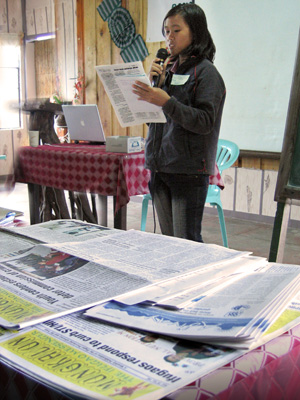
Day 1 session's first brave volunteer reading
news selection; trusty old MBP in the background.


Thrice postponed, this workshop was something that grew on me, as I intended my appearance mostly in support of my colleague's writing segment only; the design and layout component would be a postscript to that workshop, unless the participants relayed further interest in the design and layout aspect of publishing a newsletter, which meant I had to be prepared with something; I normally can give an impromptu talk on the publishing process, as I had done in some previous workshops anyhow.


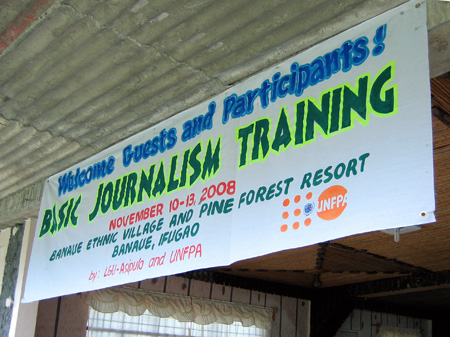
A welcome banner is a nice touch.


This workshop later transformed into a tightly-planned, full-blown editorial and publications seminar because the organizers, the municipality of Asipulo, Ifugao, backed by funding from the UNFPA, intended a 3-day workshop to be participated in by 40 attendees from both the local government unit and selected high school students and their advisers.


Ready and attentive, the selected high school students
will be staff members of their school newsletter.
(Photo by Isabel Templo)


What transpired on Nov. 10-12, the final schedule, would be part of a series of workshops to the Ifugaos, the fourth held so this year in the province, by my colleague and I. What makes this different from the first three is that the activity was organized by the local government, with teachers and students formally attending alongside municipal employees.


The first of three batches from different national
high schools of Asipulo who made it to the first-day session.


This particular workshop's budget had to be reduced at some point: the intended 40 heads came down to about 33; the venue was moved from Isabela Province to Banaue, and the number of days reduced to two, from what would have been three straight seminar days. Having it in Banaue was probably the best decision the organizers made, especially since they also transferred the venue from Banaue town to a resort located in Aparanga-o, or 7 kms. north of the town center. There, I got to meet Doe, a female deer, yes, owned and tended by the resort owner himself, Andres Dunuan, a genteel and gentleman farmer who really was a former mayor of Hungduan. Mayor Andres married a softspoken Banaue lady and made their base there upon his retirement.

Andres Dunuan, former Hungduan mayor, farmer, resort owner
and articulate guide to the resort's living museum exhibit


Interacting with Ifugaos in formal and informal events is always fulfilling in the sense that not only are they warm and hospitable, they are also very polite and are eager learners who, in turn, share their lives through their stories.


No time wasted discussing an assignment during dinner break


From all workshops handled thus far, I found the majority of Ifugao youth inquisitive yet mostly quiet and go about tasks assigned to them without ado. They are keen observers who know how to enjoy themselves and be in the moment. The older ones are mostly quiet, too, preoccupied with physical work or wrapped in their thoughts, but answer queries in simple and direct terms.


Lunchtime chill outside of seminar venue, almost visibility
zero past the path going up to the highway.


We were billeted in a separate cottage because it is the only one equipped with hot shower. But the shower only warmed the water at best, and lasted only about 5 minutes when I used it. The heating device was a total no-match to the cold weather.
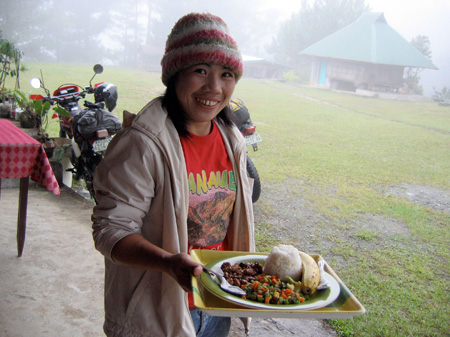

Grace, one of the resort's personnel, serves a full lunch;
our cottage by its lonesome in the background.


Even the Ifugaos themselves, the Asipulo attendees from the southern part of the province whom we expected to at least be acclimatized to the temperature, thought their protective wardrobe insufficient during the evenings. The teenagers, however, could still brave the 5 o'clock early morning chill as they wasted no time dipping in the icy pool water throughout their stay, a total of three chilly morning dips in one of the resort's amenities.
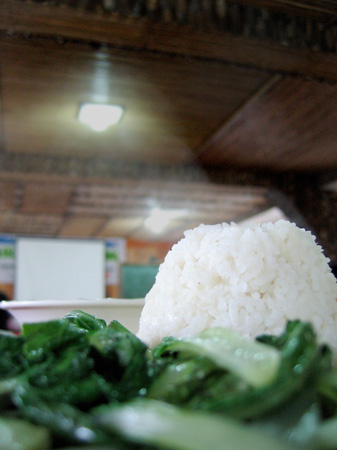

Veggie viand for us—fresh harvest from the resort's organic garden


When meal time came, we found out that one had better heed the invitation to dine because it did not take a minute to cool down newly cooked, steamy food in that weather.


It is interesting that the municipality of Asipulo had thought of reviving their community newsletter and the public high schools as keen in continuing theirs. Many of the selected student-attendees live in mountain farmlands without electricity; I attribute their diligence to school work to the fact that their lives still do not revolve around the latest urban celebrity gossips, or mindless telenovellas that take up a big chunk of their time which they devote to house chores and accomplishing family tasks. Reading among students, therefore, as well as writing and being able to understand information correctly, is taken rather seriously. So unlike many youths of their age from other parts of the country.


The fourth batch of students with their adviser (seated behind), travelling from the farthest barangays of Asipulo, took all day to get to Banaue for the seminar and arrived at dinner time. Here, they still managed to listen to an overview of the sessions they missed. Right after this short session, however, the student in black (front) briefly lost consciousness due to exhaustion from the trip and the sudden Banaue chill. Mayor Andres (the resort owner) and their adviser were in command of the situation and the student was fine and participating actively the next day.


They are, however, not nescient of current events and things related to the 'now': they have cellphones because it is necessary for communications, they are aware of, and know the benefits of having a computer or television; they are knowledgeable of current music beats and do have a sense of fashion.
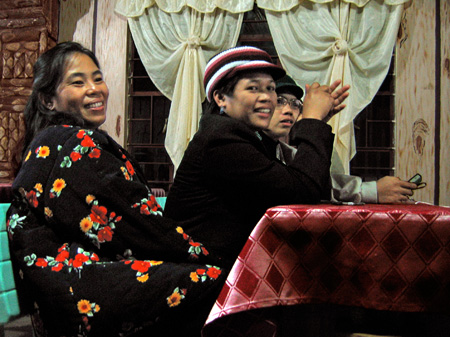

Teachers and advisers from three high schools in their own tête-à-tête


Their advisers, the female teachers whom their parents entrusted their children to, still bear the focus and dedication of many old school teachers I have come to know: attentive, intelligent and caring. I believe these kids are lucky to still not have to lose their teachers to some domestic work abroad.

The teachers were not only there as guardians to their students, but were active participants in the seminar, too, fielding their own questions, raising points and sharing their own experiences from other seminars.

After my segment on our last day, they wrote something on the board and instructed the students to sing along to an impromptu farewell song for us. A simple but very meaningful and warm gesture that helped ease the late afternoon parting of ways.
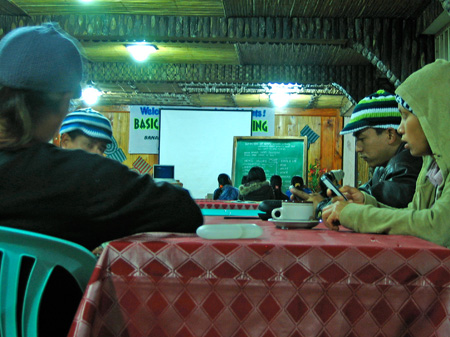

Members of the Asipulo local government Community
Relations group huddle during dinner break


Gabby, Janno, Satur and the rest of the hardworking guys (and girl) from the local government unit of Asipulo, thank you for listening, for the opportunity to meet more new friends and the chance to impart some thoughts on media and visual literacy, media appreciation and news values.

I always look forward to trips to Ifugao province and bring home with me lessons and stories from fellow Filipinos. This event is no exception.
....

Credits and links
Venue: Banaue Ethnic Village and Pine Forest Resort, Aparanga-o, Banaue, Ifugao
Organizers: Municipality of Asipulo Community Relations Office and the United Nations Population Fund (UNFPA)
All photos by krvilla/nov.08 except where otherwise noted.

Thursday, May 15, 2008

Bagful of thanks


“I have found that among its other benefits, giving liberates the soul of the giver." ~ Maya Angelou

On May 2, 2008, after composing a letter (and, eventually, editing it into a forum post), I sent out an email to a selected number of people who I felt comfortable with, I thought will not prejudge the contents and who I thought I might receive a reply or two from.

The long letter goes like this:
To cut the story short, I am here, now, posting out of gratitude. To those who replied, pledged and gave, it has been a humbling experience.

The kindness of strangers

Over at the forum, the threaded replies to my post have been heartwarming. Strangers (my fellow forum members) they are not, even if we "know" each other only by our nicknames — I have met one of the members in person, though — and our contacts have all been virtual discussions. Still, reading their posts made me feel that each one was sincere. Some, as per my request, have mailed me directly.

"Dr. Anonymous" of Philmug.ph, gracious donor, personally handed his 9 bags to Jod, our rep, in his office.

"FebruarySong" and "kate" have communicated privately.

"achtungbaby", "coolpix", "super_ed", "picoy", "penmanila", "treb22", "Macmon", "freelancer", "hungryalien", "rvaph", "tjgato", "assdoc", "rosea", and "bluegenes" have all been encouraging.

Thank you all.

What friends are for

Production colleague Marlette has prepared a couple of backpacks and a pair of shoes for pick-up. Marlette, thank you.

My cousin May's friend, GB, inquired about pretty much the same stuff as what Marlette has prepared to give. Friends of friends, friends of relatives have all been responsive.

To May and GB, Gerald, the recipients' organizer, said that they will welcome whatever is voluntarily and openly given.

The joys of family and hearth

An awesome response has been from cousin May dV, who decided to make her forthcoming birthday celebration a Bag Drive event.

Initially replying to say that she'll try her best to gather her collection of conference bags:
"yes, in fact i do have unused and slightly used conference bags. i will endeavour to look for them this weekend. and will ask my officemates if they would spare theirs, too."
she followed her letter immediately with an offer of not just helping with solicitations but making the drive a birthday event:
"hey manang,

i think i would like to help you with this as part of my birthday celeb this May 2008. kahit na sa pag-solicit lang ng mga bags for the schoolers..."
and eventually furnished me a copy of her birthday email:
"mga friendships & relatives,

as part of my birthday celebration this year, am helping out my 1st cousin with this BAG DONATION DRIVE. grateful if you can spare some of your (unused/slightly used) conference bags for the highschoolers/grade schoolers in Asipulo, Ifugao - click link to take a virtual trip to Asipulo.

in lieu of your birthday gifts to me (hehe), kindly give your bags to me on or before 18 May (my brithday) for forwarding to my cousin's group. they have moved their trip to Asipulo on an earlier date, on May 25, before the children get busy with their [school] pre-registration/registration activities.

warm regards,
MAYO"
Trust May to connect fast with her network, she being the clan's one-person text brigade operator for family matters such as get-togethers, crises and milestones. May took from her mother, my aunt, and took over her mom's role as the alternative cornerstone of family gatherings and goings-on when my aunt passed on.

May has been in the NGO circuit for more than a decade now. Her work has afforded her direct contact with grassroots-based communities and its members. Thus, when my letter landed in her inbox, the concept of sharing touched a chord common to both of us.

May sent my letter to her friends and the responses have been great. In particular, another cousin, Ate Candy, has sent out word, too, and pledged to include some school supplies pooled from her friends and office mates and, as of this post, has had them already delivered over to May's office: a whopping 26 bags, 54 pencils and some notepads! Wow! That's on top of the 9 bags we got from Dr. Anonymous, some bags from my colleague, and two more found inside my cabinet, and whatever else will be received on the 18th at May's party.

Ate Candy wrote:
Grabeh May! Sa bahay ko pa lang, me 12 na akong conference bags dun, pero most walang sling. I have 3 decent ones which would really be ok sa highschool student. Dalhin ko sa Kamuning.
Thanks, Ate Candy!

It takes a village

What more can I say beyond thank you to all who read and forwarded the email, read and replied to the forum post?

That I have so much to be grateful for, foremost of which is the validation that people in general are innately nurturing and caring. Second, that it takes a village to make things happen faster and in a bigger way no matter how simple the request.

Close friends and relatives can attest to the fact that solicitation is not one of my strengths. When I mentioned at the start of this post that I was worried about my email being prejudged, it was really more of a fear that my email might simply be ignored. No matter, as even when composing the mail, however, I was totally resigned to the fact that people will have one reason or other for not responding, and, whatever the reason, I would understand why.

On the the other hand, upon hitting the 'send' button, I felt some kind of liberation and sense of achievement at being able to finish the letter and actually sending it out and posting it to the forum. That both were received positively was a total bonus.

Liberation

The feeling of liberation is similar to how it felt like when I rode on the back of a motocross motorcycle last year on the descent from Pula to Lagawe on rough, narrow, steep and winding roads that turned 'round the mountain side. Dabert, of the Asipulo Municipal Agriculture Office (MAO), my knight on the not-so-shiny troublesome bike, was kind enough to accommodate my request for a ride back to the Lagawe lodge to retrieve our things so we can join the rest of the guests staying overnight in Asipulo at the JCAMPBELL Park last year.

I had fair warning that the only available ride to Lagawe was by a motorcycle in that late hour. It so happened that the only motorcycle available wasn't even Dabert's, and although he knew the bike wasn't in the best condition to make the dash to Lagawe and back, he tried. And the best of efforts he did, in spite of the fact that he felt my nervous grip around his waist a tad too tight for, like, the first 30 minutes' ride on the bike (he told me this later) and he read no real, physical sign of confidence and trust from me despite my putting up a gung-ho front. But that was just for the first 30 minutes or so, the equivalent of more or less 10 kms (or approximately the distance from the Quezon City Hall to the Manila City Hall): a coverage of just about a fourth of the entire one-way travel.

The circumstance was such that throughout this stretch, only about 12-15 percent of that initial 30-minute backride had roadside houses and pedestrians along the way. The rest of the trip was just Dabert and myself on the lonely, rough, winding and narrow downhill road with the mountainside to our right, and deep ravine to our left. No helmets and other protective gear for us both, just a tricky 2-wheel vehicle on the trickiest road there is.

After about 30 minutes and a lot of mental battle, I thought: Pirsig. Robert Pirsig. The essence of that Robert Pirsig moment: "Just let go. Whatever happens will happen, but trust that whatever happens, happens for a reason." I felt my grip around Dabert's waist loosening, slowly. When I finally let go and relaxed, only then did I feel the wind on my face and the empty space between my feet and the road (my legs were hanging from where I sat on the big bike the whole time).

The fact is, this post is not about me but about those who already were liberated ahead of me and have learned to trust.

After all, my colleagues and I are just a conduit to everyone's generosity in this effort.

Updates

We have so far received an assortment of bags. In particular, those from "Dr. Anonymous" were not just sling bags but big, sturdy, zippered tote bags. They'd be useful as personal carry-alls for those studying in other provinces and staying with relatives or in dorms.

Needless to say, we weren't prepared for the type of bags and the quantity received. May asked if we could share the other bags with others besides the kids.

Yes, we did think of other possible recipients in Asipulo: appropriate bags for the daycare center volunteers and health workers.

Our trip back to Asipulo is again moved ahead of original schedule because of the kids' participation in municipal and organizational activities. CLT, my colleague, will leave ahead of me on the evening of the 17th, bringing what she can.

I, on the other hand, have committed to be at my cousin May's birthday bag drive on the 18th, and will catch the last bus to Ifugao province right after the celebrations.

I will update this post with pictures when I come back.

To you all, thank you.

Updates-2

More from May | 6:13pm | 16 may 08:
1. Noemi Jacob - 5 black conference bags
2. Ding and Helen Espinar - 12 backpacks, assorted color/design (new)
3. Evelyn Daplas - 7 green&blue mailmanbag-type conference bags; 2 black conference bags; 1 chinese-design ladies handbag & 1 "Candies" shoulder bag.
4. May Reyes-De Vera - 3 black conference bags

more on sunday i hope... see ya!
=)
MAYO

Saturday, June 9, 2007

Faith

Kiangan, Ifugao Province highest point 2,297ft
5:30 am, 05 June 2007 Early-morning clouds blanket Lagawe.

This is what greeted me on this morning. When the feeling is indescribable, the only way to fully take this in is to believe what I see. Then, after I have opened my heart, only tears can acknowledge its presence.
. . . . . . . . . . . . . . . . . . . . . . . . . . . . . . . . . . . . . . .
Partial photo credit goes to itemplo

* * * * * * * * * * * * * * * * * * * *

Thursday, June 7, 2007

Pure

Pula, Asipulo, Ifugao 450m-1,935m above sea level

Pula is a sitio of Asipulo, Ifugao Province's newest (they say 'youngest') municipality, which is accessible from historic Kiangan town by a long stretch of road that is occasionally paved, frequently rough and bumpy and is never without surprising twists, turns, inclines and descents.

Road to Pula
The rough journey to Pula is soothed by an unending vista of mountains and valleys and terraces, though not the majestic kind that is popular like in Banaue; of pockets of roadside houses, chickens crossing, dogs sunning, and locals engaged in farm work. Clear streams and puddles break the path. Best of all, the air is pure.

When we got to Pula to attend an event, we were told that it was the first time the locals had ever hosted a gathering of such size with guests from elsewhere, let alone foreign guests. We totaled about 50 or more.

Pula is about 20-30 minutes from Asipulo's municipio, depending on the mode of transportation. We were brought to Pula in a local jeep, one which makes the jeeps of Manila wimps by comparison. More functional than anything, the structure of the Ifugao-made jeep is what heavy-duty is all about. It is roomy, longer than the ordinary jeeps that seat 10 people per bench; it is higher than an off-road 4x4 with roofing supported by a grid of exposed angular bars. It is made that way to better carry additional passengers and goods on its roof. (My other trips were as a passenger on a motocross motorcycle and in a tricycle. The motorcycle ride experience will be in a separate entry.)


Basic
Life in Pula is basic. There is one house in the centro that sells lowland comforts such as Coke, cigarettes by retail, sachets of shampoo and such. Because of the altitude, Coke is sold unchilled but still kept cool by the weather. Jonalyn, one of our local hosts, mentioned that sometimes, bottles of cola are buried in the ground to keep them cool. There is no electricity in Pula. Some houses in what is the centro are close to each other. Our host's ancestral house, however, is up deep in the mountains, accessible via a trail that took us, the unprepared and uninitiated, an hour or so, but which the locals traverse leisurely and sure-footed for about 10-15 minutes or maybe even less.

One has to stay in Pula overnight like we did to learn what it is like to live in a pure sense: water flows straight from the mountains through a hose that is hung overhead, rice is from the fields, vegetables are picked when ready to be cooked and coffee &mdash real coffee &mdash is harvested from the robusta trees that grow wildly in the surroundings. Meals are simple and shared and the host members make sure there is food for everyone. There are comfortable beds in the house, yes, and more chickens running about; pineapple and camote abound. Surprisingly, our host has electricity up in the mountains powered by solar energy. But it is only for lighting in the evening, nothing else (I did see a mini component, but perhaps only used for special occasions). Life is simple and seamless; domestic work is shared by both men and women and, even without the benefit of a timepiece, chores flow naturally from one to the next. Nothing is in excess and everything is doable and just right.


The latrine is separate from the house. One's private rituals are blocked from view by hardwood slabs that cover only the essential. There is no malice among the people of Pula anyway. However, chickens innocently stopping by from the gap between the ground and the slabs may witness the ritual. Again, water is not a problem.


The Kalanguyas, Ayangans and Tuwalis
Asipulo is made up of three major tribes: Kalanguya, Ayangan and Tuwali, all sub-categories of Ifugao.

The people of Pula, probably the most hospitable I have ever encountered, are mostly Kalanguya and Ayangan and subsist on farming and gardening &mdash though not the leisurely gardening we know. Gardening means growing crops in one's immediate surroundings for domestic consumption. If the harvest is good, the extra produce is brought down to the bigger towns to be sold. Pork and chicken, of course, are the main sources of protein. However, pork is luxury, chicken is special; fish is sometimes available but rare.


This place is where chivalry is alive. Women are highly regarded and treated with respect. There are small, but increasingly frequent, cases of abuse but this is caused by outsiders who marry into the locals. Sadly, these outsiders are generally referred to as Ilocanos, mostly from the nearby lowland areas of Nueva Vizcaya or across mountains from neighboring provinces.

All the people of Pula, and Asipulo in general, call themselves Ifugaos regardless of tribal identity. Ifugaos are hard working, well behaved, shy, quiet and clean. They may occasionally stare but not to size you up like they do in the lowlands. They weigh their responses carefully so as not to offend or be misinterpreted. They all speak, or understand, Ilocano but have their own dialects. Above all, Ifugaos are peaceful. Asipulo, we were told, has the lowest crime rate in all of Ifugao Province. Why? Because disputes are discussed among the elders with the aim of settling any arguments in an even-handed and justifiable manner. In fact one can feel the peace and sense that the people themselves are at peace with their existence. It is purity in the simplest of terms.


Richer in more ways
Asipulo is frequently indexed as a fifth-class municipality. To many of its residents, being classified as such may not be important to them and their existence &mdash many are literate and most people are polite. They may belong to such a classification but poor they are not, certainly not in spirit and resources, and, most especially, goodwill.

Pula is not for the faint-hearted, closed-minded, humorless and ill intentioned. My Pula experience is such that I bring back with me its wealth: the strengthening and reinforcement of the Filipino values of pakikisama (camaraderie, cooperation), pakikipagkapwa-tao (regard for others) and just downright appreciation for things pure and simple.

Hello, Palawan! Day 2 (Part 3) - Iwahig Firefly-Watching Ecotourism and Wildlife Park

A rather extended post about fireflies and stars ✼ ⇠   DAY 1  |   ⇠   Day 2 Part 1 |  ⇠   Day 2 Part 2    | Day 3  ⇢ With more g...